Lesley McGrath

Reserve America

Feature addition to the ios mobile app

Concept Design & UX Case Study

Reserve America’s mobile ios app allows customers to book campsites, RV space, and buy tickets to parks. It’s no surprise that COVID-19 has affected individuals, families, and businesses on some level. With travel restrictions in place and people more hesitant to travel, it means that a lot of us have been forced to slow down and change our habits. And it seems that a large number of Americans have turned to camping to scratch that itch to travel. There has been a massive increase in the number of campers since 2020, which means campsite booking apps are going up against some of the giants in the industry such as Airbnb. This is where Reserve America’s mobile app can come in and really fill that need.

Audience
Avid campers and first time campers located in the U.S. who are searching for their next adventure while they’re on the go. They are familiar with other non camping but still travel booking apps, so they have a certain expectation in mind when it comes to booking accommodations on their iPhone. 


Role
I was one person in a group of four. My role focused on research and synthesizing our discoveries in order to make design decisions. 


Constraints & Scope
We were not working directly with developers, so we were unsure if our designs are feasible given the data Reserve America already has. Our main scope of the project was to define and design the minimum viable product in terms of a feature addition for the iOS app

Challenge

The desktop website has a lot to offer, but the mobile app is limited and not very user friendly. Campers are able to book campsites, but the process of finding one is honestly quite painful. Campers can only search by location and need to scroll through an extremely long list of details before they can decide if it’s a right fit for them.

Outcome

We feel our new addition of the review feature and incentivizing the user leave reviews (and photos!) will help Reserve America stand out amongst the campsite booking apps. As more and more campers share their experiences, others will feel more confident in their bookings. And if campers have even a small incentive to leave a review, they will be more likely to choose Reserve America as their campsite booking app of choice. Now that’s a win-win if I ever heard of one!

Solution

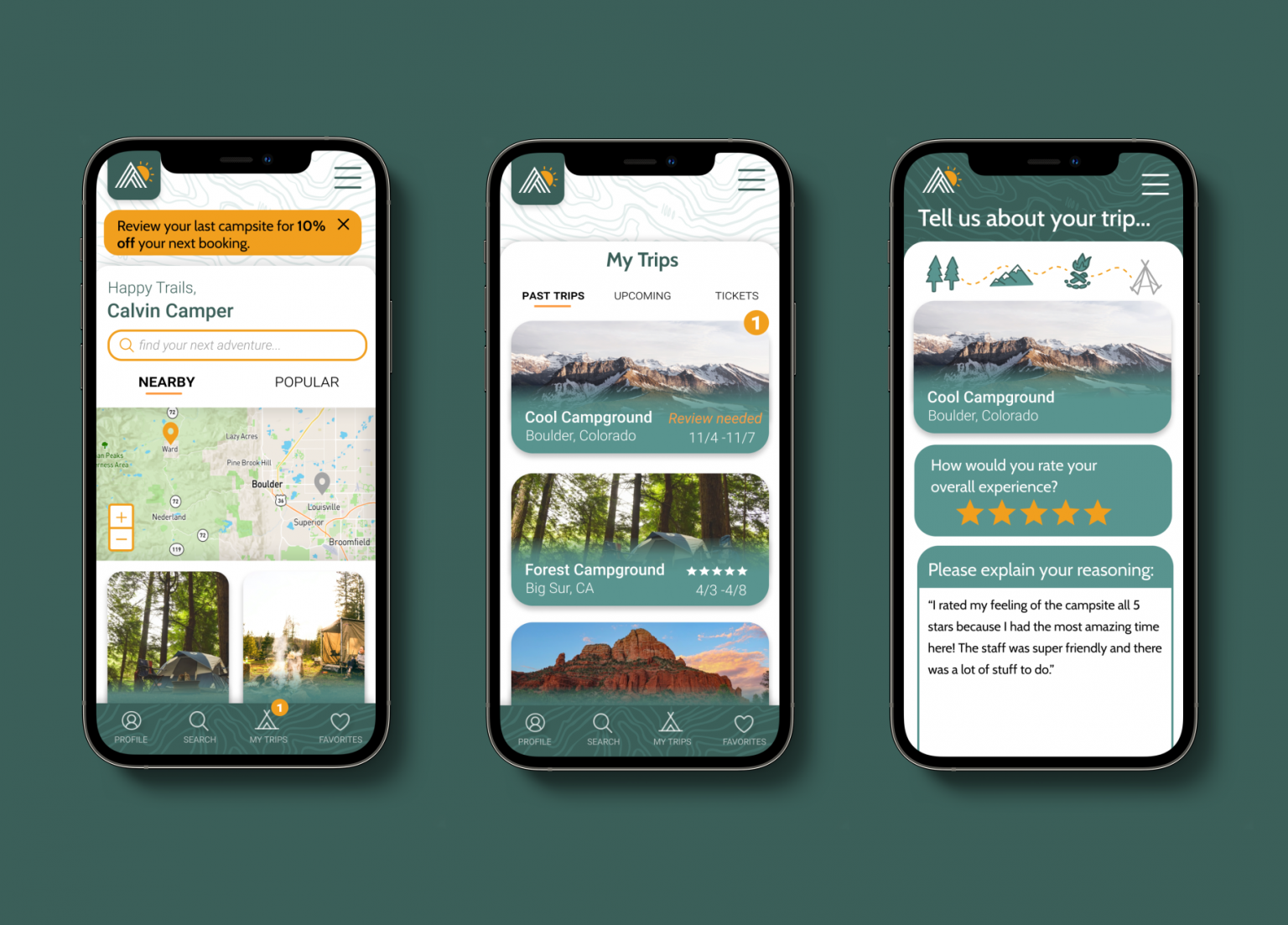
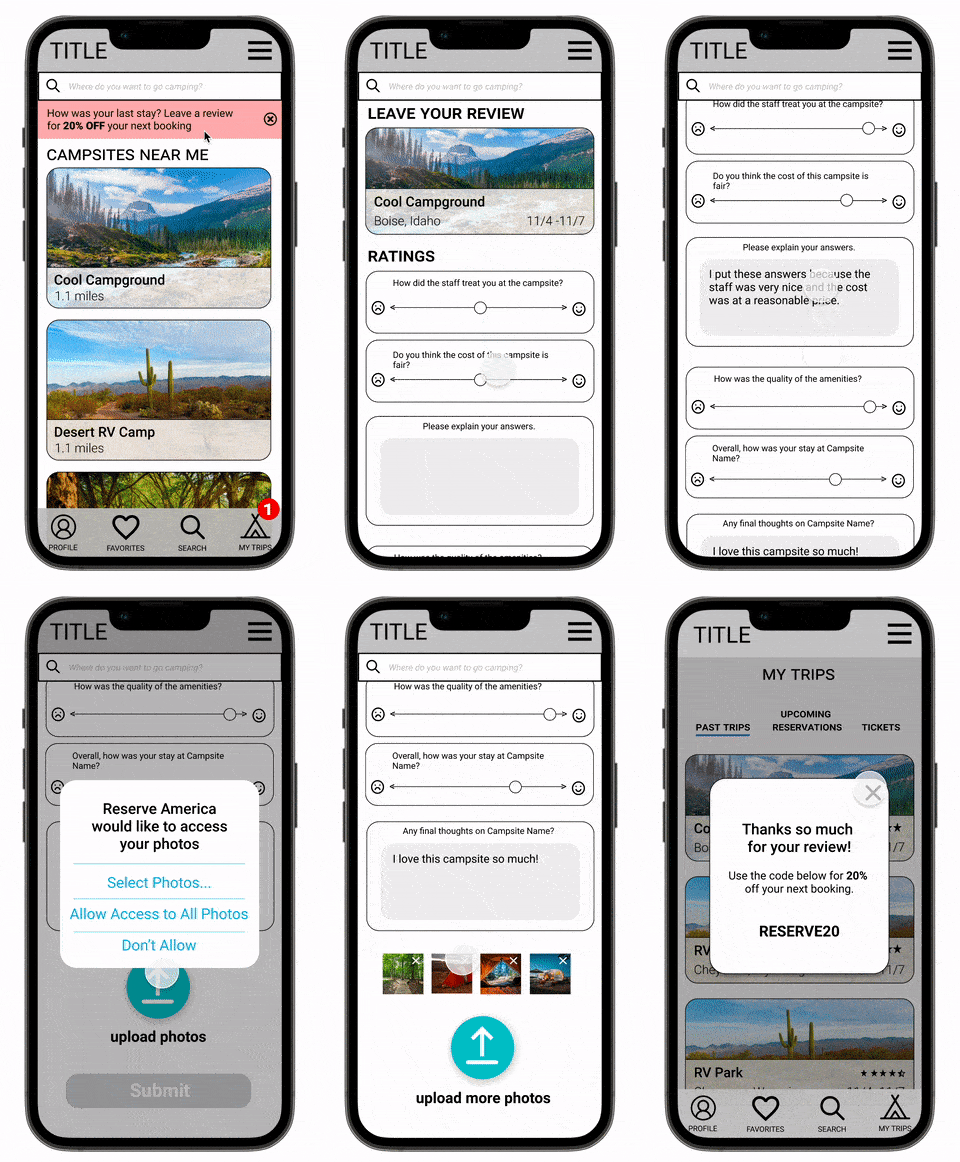
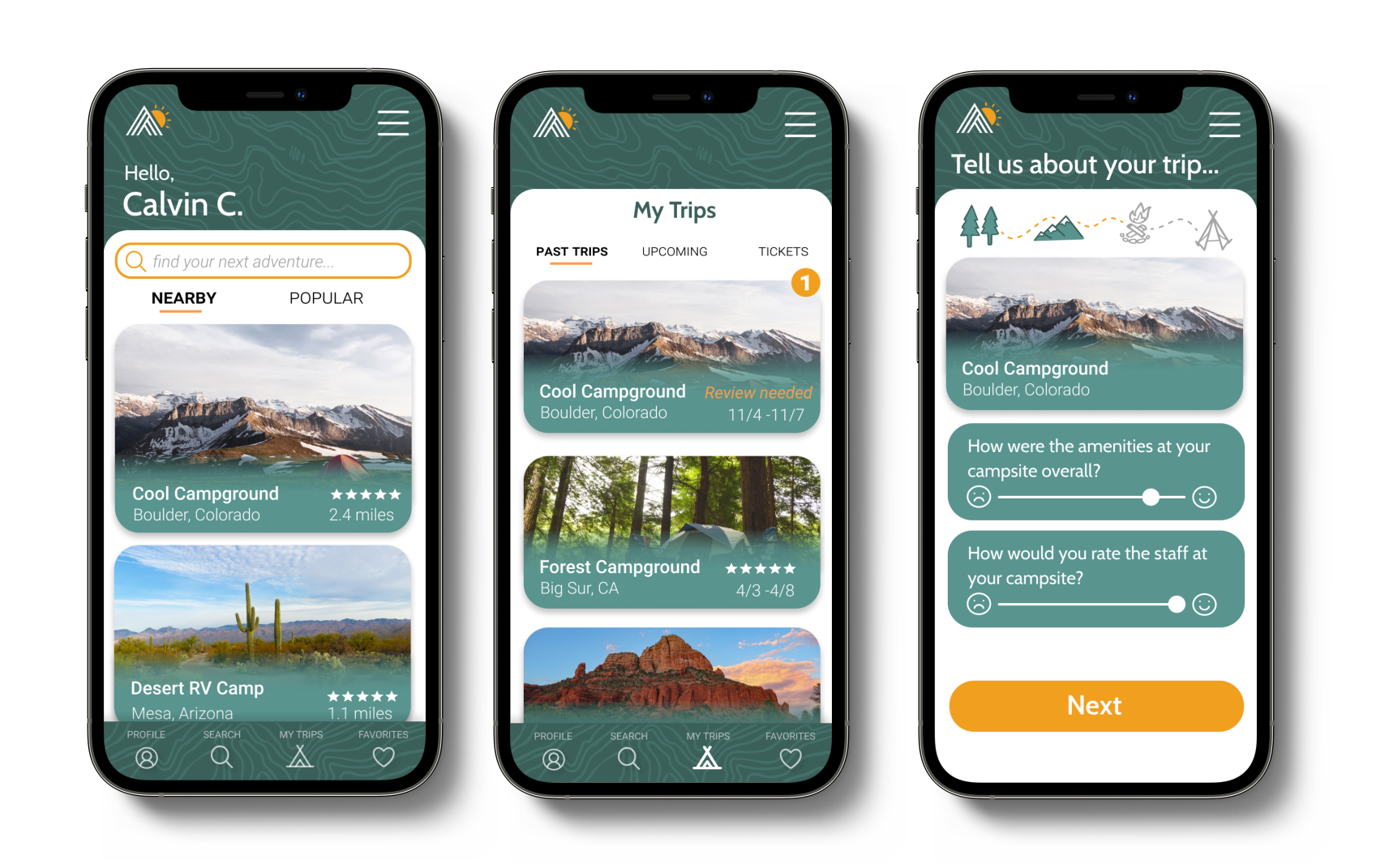
With the new feature addition of reviews, we knew there should be a way to incentivize campers to leave their feedback so Reserve America can build up a solid base of reviews. We opted for a reminder banner near the top of the screen as well as an in app notification on their “My Trips” page. The user can dismiss the banner, but the notification still remains until they leave a review.

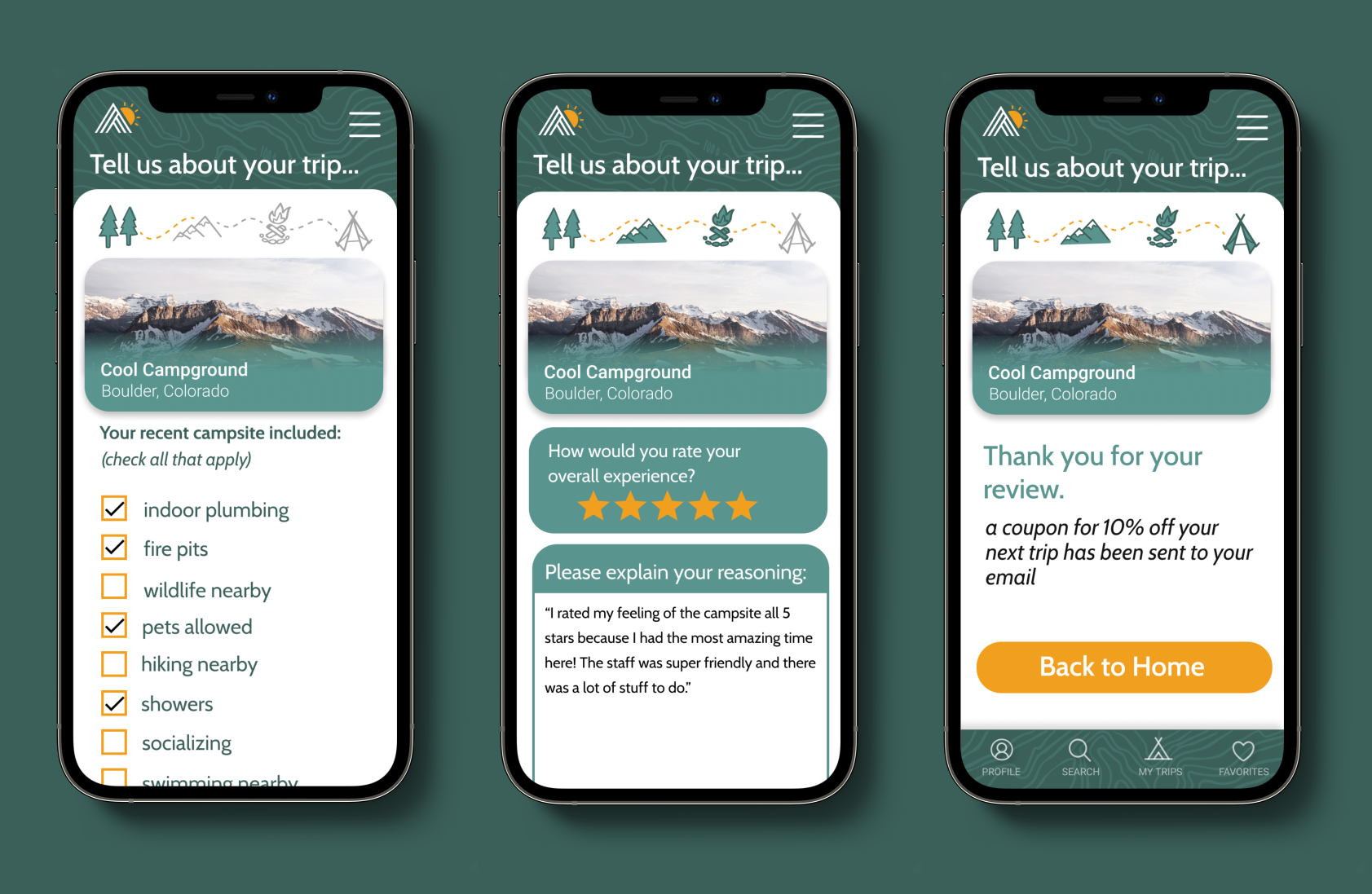
For the review itself, it is broken into a few steps so as not to overwhelm the user. The camper can check off amenities that were included which would help fill out the actual campsite page. They then rate a few individual items as well as their overall stay, and finally, optionally upload a picture. They will then be sent a coupon to their email for a percentage off their next booking. 

How exactly did I get here?

Read on for the full process ⬇

Research

Goal: Build an understanding of the
industry and identify needs

Competitive Analysis

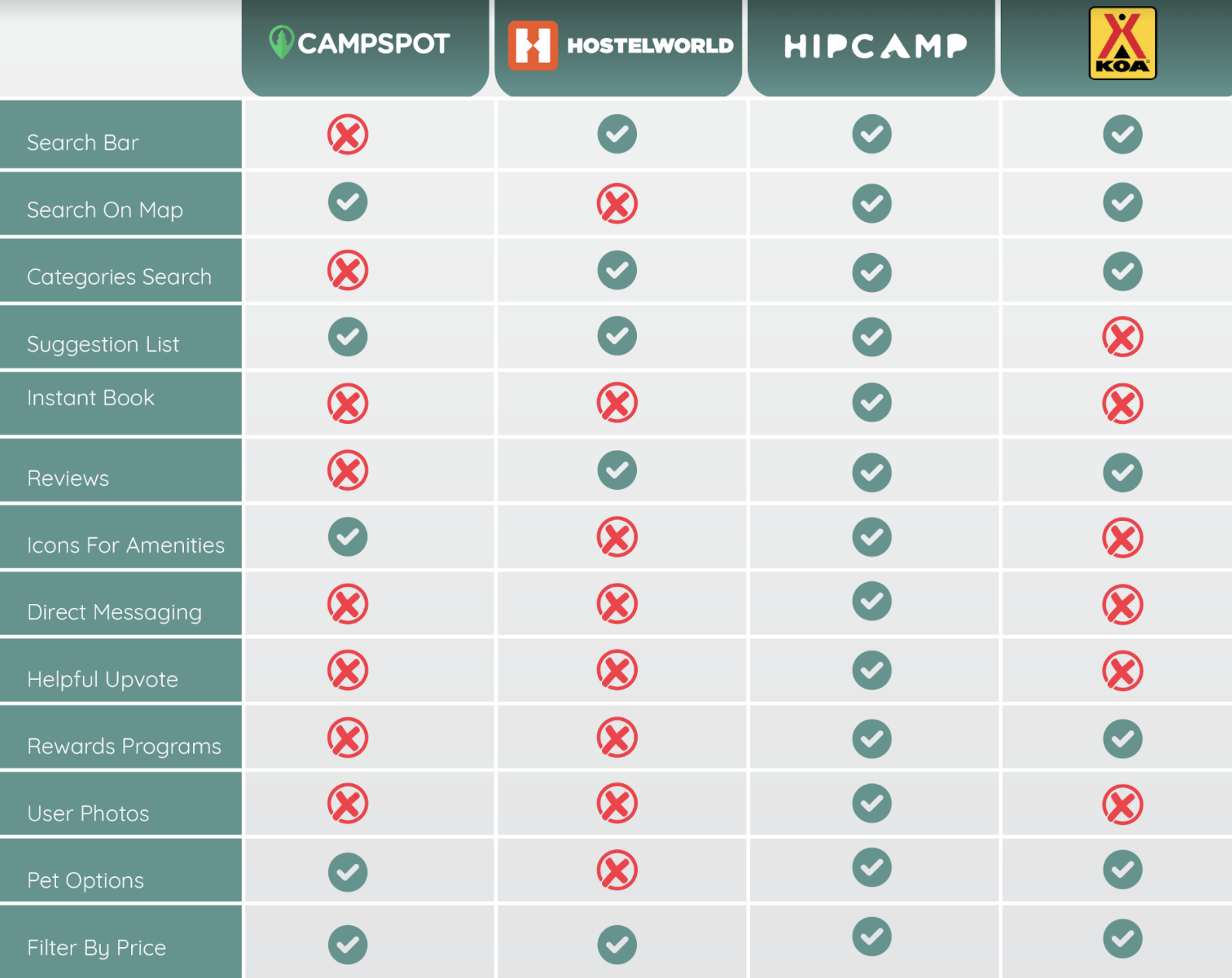
Looking at what our competitors succeeded in and where there is space to improve was key to narrowing our focus on what feature to choose. We chose four frontrunners in the industry to see what the campers on Reserve America may also benefit from. 

What we found

One thing that we noted was that HipCamp took the cake when it came to features. They are clearly the one to beat, and some features that make them stand out are not only having reviews, but user photos. We also came to the conclusion that it would beneficial to have the campsite cards on Reserve America to be updated to a more clean look, but still have all the relevant information any level of camper would want to know.

Impact

We live in a world now where everyone wants to know what other people are saying about something whether it’s a place to stay, a restaurant, or a product. And with a large increase in the number of campers recently, it may be helpful (especially for those new campers!) to read about others’ experiences. 

Survey Says...

With the intention of discovering more about people’s habits and feelings on travel bookings in general, we decided to create a survey to send out. We were quite surprised at how many responses we got, and even more surprised to find out that there was a definite theme emerging from them.


55% of respondents consider reviews

60% of respondents find that photos are important in a review

40% of respondents never leave reviews online and 10% often do


What this data is telling us is that people rely on reviews and photos when making booking decisions, but not a lot of people leave them. The results from our surveys really validated what other research was suggesting: give the people a way to read and write reviews!

So, what do we need to figure out?

The camper needs a way to read reviews on a campsite they are looking at so that they can feel confident in their booking.

Reserve America needs a way to incentivize users to leave reviews so that they showcase a more robust campsite page.

Ideation

Goal: Create an experience that
meets the needs of the business
and the camper.

Initial Sketches & Ideas

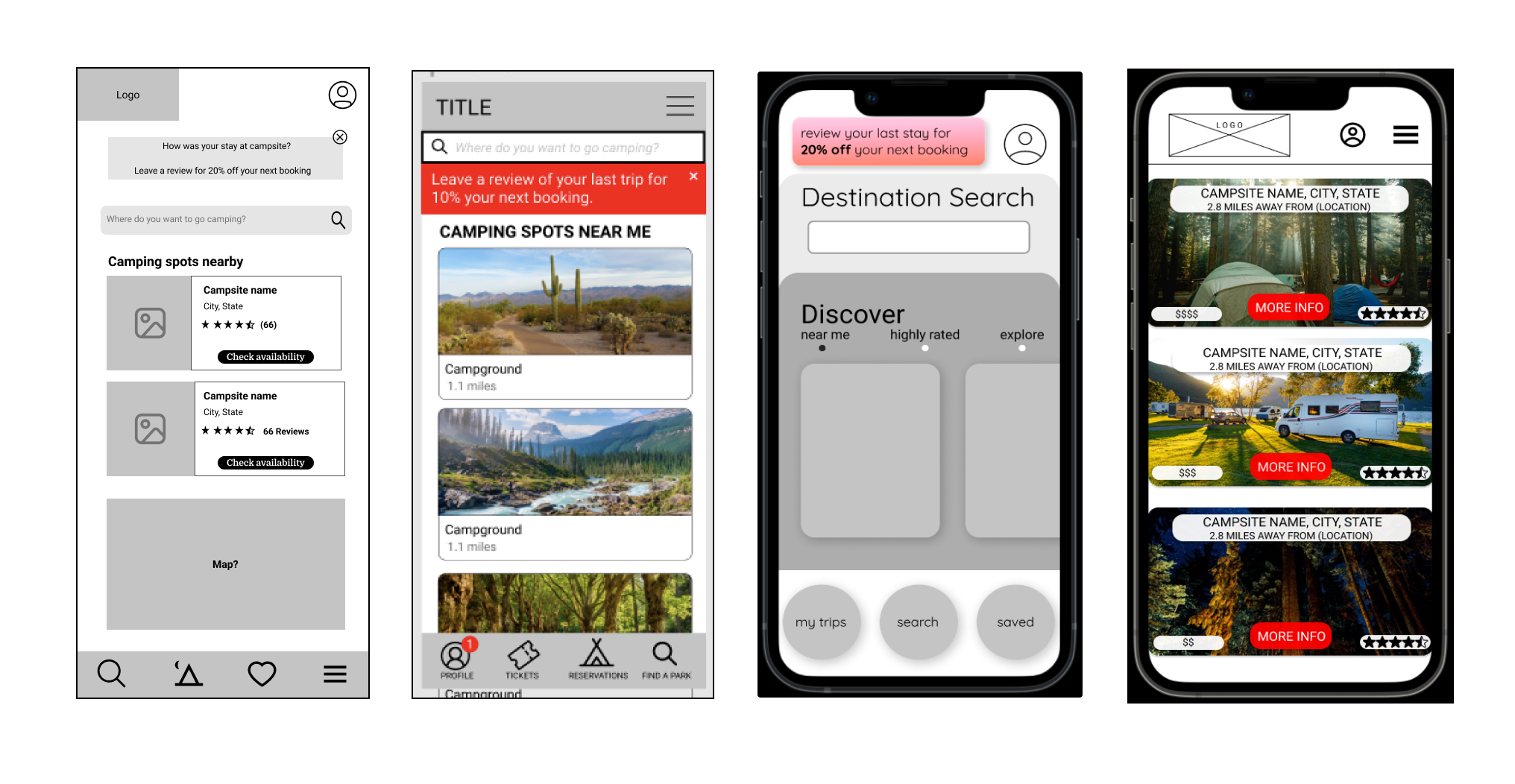
We were all pretty excited that we defined our MVP, and were anxious to get started on sketching to get some ideas flowing. 

Design Decisions

As a group, we ideated a lot and came together to agree on a few key elements that we definitely wanted to include. In order for campers to read reviews, we first need campers to write them! So, we opted for a reminder banner at the top of the screen that also incentivizes users to leave a review. For the review page, we initially kept it all on one screen with the ability to write in, rate, and upload a photo.


For our navigation, we decided to have the main pages a user would frequent at the bottom which is a common pattern among other ios apps that users will already be familiar with. Also, you know, easier for those thumbs to get to.

Test & Develop

Goal: Facilitate usability testing and iterate.
Rinse and repeat.

Usability Testing

We thought our idea of adding reviews to the app was the right one, but will other people find value it in? We relied on two rounds of five usability tests that used both qualitative and quantitative metrics to determine success. With a mix of seeing how long the task took, the success rate, and overall feelings about the process we were able to get a better understanding of what worked and what we still needed to change.


Take One

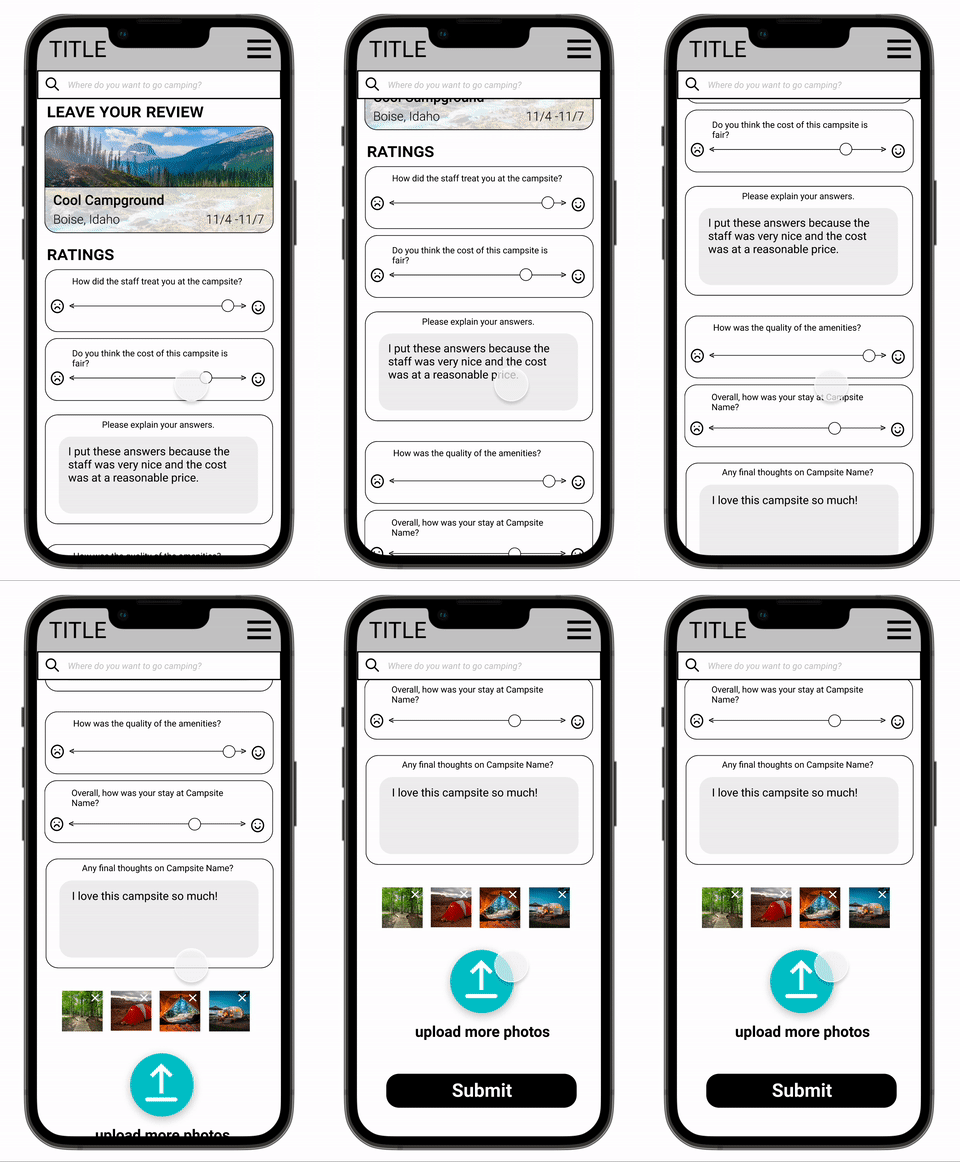
During the first round of testing we found that people found the review page a lot to digest at once, so we decided to split up the review into three different screens in our next iteration. 


Tests also revealed that the sliders as a rating were a pain point in general. Was it just because people were testing it on their computer? Was it a limitation we didn’t flesh out fully in Figma? This was definitely something to keep in mind. 

Take Two!

The review form split up into a few screens  seemed to be successful. No complaints this time around about an overwhelming form!

With the screens in a more high-fidelity prototype, users mentioned that the difference in the home screen to the “My Trips” screen was not apparent. Although we wanted to be consistent in our designs, maybe there is another way to make the home screen stand out on it’s own.

Lastly, those slider ratings came up again as a pain point. Maybe we should just switch to the standard star rating?

Impact

Seeing how users interacted with the app and getting their direct feedback was invaluable. With their help, we took the home screen design into consideration and mocked up…oh boy…honestly too many options to count! But we came to a consensus on the design which can be seen in the solution. 

Next Steps & Reflection

Being a part of this project helped me develop my skills in taking the valuable data from research and using it to drive customer-centric designs. By doing that, I was able to better articulate design decisions every step of the way. Next time around, I would love to do a business analysis as part of our research. This was something we learned shortly after completing the project, and I feel it would have be beneficial to know any technical constraints, how Reserve America generates revenue, and how they define success.


In terms of next steps for design, I think we still need to address the pain point of the sliders. Gotta listen to that data and what our users are saying! We would also like to attack streamlining the booking process on the app. It would be a good idea to work with developers to see what the capabilities and limitations are for building a better booking process. 

Some kind words from my group:

Let's Chat!

Have questions about my work? Want to learn more about what motivates me?

 Reach out! 

Copyright 2026 © All rights Reserved. Design by Elementor